Let me begin with a significant point; the natural hair community grew out of commonality. For so long, something was missing in the haircare industry for people with naturally curly hair, coily hair, kinky hair, overall textured hair. Basically, if you didn’t have fine, straight hair, there were no products, no styling tools, nothing to help you care for your natural hair texture. All kinds of products and tools could help you turn your hair into straight, more “manageable” (I use that term very loosely) hair, but nothing to help you care for and maintain your natural texture.
Then slowly but surely, we start to see this emergence of haircare products created by people with naturally textured hair for people with naturally textured hair. Hallelujah! Over the years, haircare products for naturally textured hair have grown significantly, and with the help of social media came the natural hair community. A community of people with textured hair and the same issues all coming together to share their tips and tricks. This has been a Godsend for me as I came along early on when there wasn’t any guidance or help, and I just had to figure it out.
Just when you have something you can call your own, here comes the drama. For your education there is a type classification for hair, it runs from 1 to 4, each with a category A to C. 1 is straight hair, 2 is wavy hair, 3 is curly, and 4 is coily/kinky. Within the natural hair community, you are basically focusing on type 3 and type 4 hair textures. Now imagine my surprise when I hear that some would like to kick the type 3 people out of the community. Typically mixed/biracial people often have type 3 hair (a looser curl), and black people more often than not have type 4 hair (a tighter coil), and here is where texturism and colorism meet.
Some in the natural hair community feel like the face of natural hair should be people with type 4 hair and feel like type 3 hair people need to take a back seat. Much of the drama in the community is centered around “outsiders” taking over black spaces and black people allowing it. Much of the media or marketing surrounding natural hair products or brands showcase light skin women with a looser curl pattern. The natural hair movement is equated with “going natural,” meaning wearing your natural hair the way it grows out of your head. Some type 4 people feel like type 3 people have never not worn their hair “natural” because type 3 people may or may not have chemically processed their hair before, whereas that is the norm for most with type 4 hair.
We’ve seen this issue play out in many forms in the black community, media, beauty industry, toy industry, etc. Light skin or racially ambiguous people are often highlighted for black roles on screen, makeup companies often exclude darker skin tones in their product ranges, and the representation is often not there in children’s toys (an official black Barbie wasn’t introduced until 1980, and she still had white features). Colorism is an uphill battle that the black community has been fighting for years both in and outside the community, as we can see with texturism. Bleaching creams and plastic surgery are rooted in colorism, and some are drawing parallels to twist outs, braid outs, Bantu knots, and other natural hairstyles being rooted in texturism. Some say texturism promotes this obsession with a looser curl pattern and these hairstyles help you manipulate your hair for that reason. Just as in colorism, lighter skin is beautiful; in texturism, looser curls are beautiful.
It would seem that with so much against the community, people would come together to celebrate the victories and unite to continue the good fight. Still, these issues are permeating the community like a disease. In my first line, I wrote that the natural hair community was born out of commonality. Whether my hair is exactly like yours didn’t matter; we experienced the same issues because there were no solutions for us. We united under a common cause, and now we’re letting a petty viewpoint tear us apart. The community is no longer welcoming and plagued with drama. Many popular influencers that had major impacts on the community are distancing themselves from the community because this toxic ideology has overshadowed the original message.
The natural hair movement has been so vital to changing minds and lives. People proudly wearing their natural hair have been told it’s unacceptable, not beautiful, and unprofessional for so long. The natural hair movement and those in the community have persisted and have made phenomenal changes, e.g., The Crown Act. We’ve come too far to let petty drama tear down the community and set back the movement. At the root of texturism is a lack of knowledge. People hate what they do not understand. The best part of the natural hair community is the opportunity to educate those within and outside of the community. This fosters understanding and acceptance. Exclusion has no place in the natural hair community or any other community. We have to learn to stand together, or anything will tear us apart.
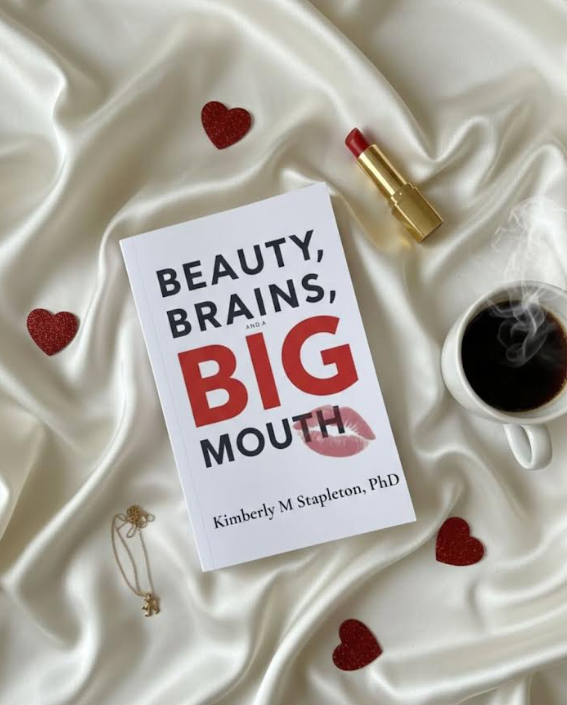
 Beauty Brains and a BIG Mouth